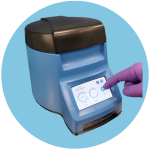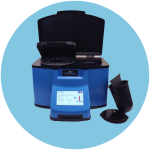
Next Advance Inc. is the home of the Freedom Rocker which automatically processes western, southern, and northern blots and gels. 
      Next Advance also produces laboratory rockers, pressure injection cells, and more.

We specialize in Homogenizers, Rockers, Pumps, and Automated Blot Processors.  Call 1.518.674.3510

Automated
Blot Processor
Capillary
Loader
Syringe Pumps Homogenizer
Cell Disrupter

BULLET BLENDER Protocols
 

skip down to:  yeast    E. coli   plant tissue   muscle & organ tissue    cultured cells 

Before using the Bullet Blender™ please note

General guidelines

order of addition in the tube: tissue, beads, then buffer.

tubes: Use polypropylene tubes.  Microcentrifuge tubes: a 1.5mL or 1.7mL tube may perform better than a 2.0mL microcentrifuge tube because the bevel on the bottom of the tube is steeper, allowing more mixing.  Use quality brand tubes such as Axygen.  50mL tubes: use BD Falcon or Krackelerbrand tubes; other tubes which are slightly different in size will note work well.

volume of sample:  When the tissue is overloaded, there is not enough airspace in the tube to allow for efficient mixing of the sample with the grinding agent.  The movement of the liquid around the walls of the tube is important and without an airspace, you will not get effective homogenization. 

- small tissue samples: As the tissue amount becomes smaller, that ratio will differ due to the limitations of handling of the small volumes.  Cutting the tissue into smaller pieces will generally yield better results. 

- with microtubes: We recommend less than 300mg (that is 0.3g of tissue) per microtube in the Bullet Blender™. You must leave at least 500 microliters of airspace in a microcentrifuge tube to get effective homogenization.

- with 50 mL tubes: For similar reasons, do not fill the 50 mL tubes with more than 15 mL total of buffer, tissue, and beads.

volume of beads:

- glass beads: 1 volume of tissue:1 volume of grinding media: 2 volumes of buffer.  

- denser beads: 1 mass of tissue: 1 to 1-1/2 mass of grinding media: 2 mass of buffer.  (When there are a lot of the denser beads in the tube, they tend to settle at the bottom and weigh the tube down from shaking vigorously, so best results are obtained when using equal mass instead of equal volume of beads to tissue.)

choice of beads:  Check our bead selection guide for recommended grinding agent for each application and the FAQs section below the guide.

volume of buffer: usually two volumes of buffer to one volume/mass of tissue

Considerations for RNA isolation: 

- Use fresh biological material and nuclease free labware, reagents, and beads.  For treatment of beads, see the FAQs on our beads webpage.

- Follow the homogenization protocol for your particular sample using Trizol® as a homogenization buffer. 

- Remove the tube and visually inspect the homogenate.  If there are unacceptably large pieces of tissue remaining, run for another 2 minutes. 

- Note that the amount of Trizol® used to homogenize the cells is less than what the manufacturer recommends for RNA isolation.  After homogenization, add the rest of the volume of Trizol® specified by the manufacturer's protocol.  For example, use 0.2mL Trizol® in the Bullet Blender™ to homogenize 100mg tissue.  After the homogenization is complete, add 0.8mL Trizol® to the tube (to meet the manufacturer's specification of 1 mL).  Next, close the tube and invert it several times (5-10) to ensure complete mixing.  Proceed with the manufacturer's protocol to isolate the RNA.

Typical disruption protocol

1. Isolate tissue from animal. Process as quickly as possible into small pieces (~50mg

each, about 1mm x 5mm x 5mm).

   • Thinner slices are better for homogenization than large “chunks”.

2. Place tissue slices into a microcentrifuge tube on ice.

   • Use between 50-300mg of tissue with microcentrifuge tubes.

   • Less dense, less fibrous tissues may be easier to disrupt, so more may be used.

3. Add cold buffer to tissue.

   • Generally, two volumes of buffer for each volume of tissue are desired to

maintain high concentrations of material to be analyzed in the lysate.

   • Volumes ranging from 100µL to 1000µL may be used depending on the

toughness of your tissue and the particular application you have in mind.

   • The contact time between tissue and adjuvant grinding materials (e.g. glass

beads, stainless steel balls, etc.) is important to disruption efficiency. There will

be some volume above which you will notice a significant decrease in efficiency,

but these results will vary with the toughness of the tissue, size of tissue pieces,

volume of buffer, and volume of the grinding material.

4. Add grinding material (if desired).

   • Use a volume of grinding material similar to the volume of tissue.

   • Use grinding material of similar diameter to the tissues to be disrupted.

5. Place tube in the Bullet Blender™

   • Set the desired power and time.

   • Close the lid and secure the lid latch.

   • Push the start button.

6. After the Bullet Blender™ has stopped, remove the tubes and proceed in your

application.

Generally, disruption and lysis are performed simultaneously for whole cell extracts.

Any inhibitors required to maintain the quality of the desired cellular material (i.e.

Protease inhibitors, Rnase inhibitors, etc.) should be added to the lysis/disruption buffer

before the tissue is exposed to the buffer.

To assess the amount of lysis in your application, use a Lowry or Bradford assay. When

starting, it is helpful to run a small pilot experiment to determine the best parameters for

your tissue processing. The protocol supplied here is a good place to start, but given

that biological materials vary greatly, you will need to determine the ideal quantities for

your experiments.


For protein or DNA applications, beads should be autoclaved or acid washed, but do not require additional preparation.  However, when RNA extraction applications are desired extra care must be taken to avoid decomposition of RNA from exogenous RNase activity.  To ensure that beads are not the source of RNase activity, we recommend washing the beads with RNase Zap® (Ambion, Inc.) or RNase Away® (Molecular BioProducts), then rinsing with nuclease free water, followed by autoclaving.


Below we list some settings from user feedback.  Please send us your parameters and we will add them to this list.

Disrupting Yeast Cells: 3 minutes at a speed of 8 using 0.5 mm glass beads. 
Test results in mg/mL of lysates, performed in duplicates:
0 min - 0; 1 min - 1.58, 1.32;  2 min - 1.94, 1.7;  3 min - 2.54 ; 2.33

E. coli and Yeast Genomic DNA Prep:  Adapted from the Rather Rapid Genomic Prep from the Fred Hutchinson Cancer Research Center.

Centrifuge 5mL overnight saturated yeast culture to pellet the cells.

Resuspend pelleted yeast cells in 500 uL water.

Transfer to 1.5mL microcentrifuge tubes, then spin briefly (5000g, 15sec).

Aspirate supernatant.

Resuspend the pellet in 0.2mL buffer (2% Triton-X, 10% SDS, 100mM NaCl, 10mM Tris, 1mM EDTA)

Add 0.2mL glass beads to each tube (omit this step for E. coli).

Add 0.2mL phenol:chloroform:isoamyl alcohol (25:24:1)

Place tubes in the Bullet Blender, running at a speed of 8 for 3 minutes.

Add 0.2mL TE, spin at max speed for 5 minutes.

Prepare a new microcentrifuge tube with 1mL 100% ethanol.  Transfer the aqueous layer (~0.4mL) from the yeast lysate to the tube containing the ethanol.

Spin the crude genomic DNA at maximum speed for 5 minutes (4°C).

Pour the supernatant off of the crude DNA pellet, then resuspend in 0.4mL TE.

Add 10 microliters 5M ammonium acetate, then 1mL ethanol (100%).

Centrifuge the mixture at maximum speed for 5 minutes (4°C).

Pour of the supernatant, then dry the pellet and resuspend in 50 microliters of sterile water.


E. coli and Yeast genomic DNA prep using 50 mL tubes:

When using the Bullet Blender™ 50 for larger E.coli and yeast cultures,
overnight cultures from 50mL to 150mL may be used. A 50mL culture will be
most convenient, as it will fit in the 50mL conical centrifuge tube all at
once.  Larger cultures will require multiple centrifugation steps
to combine the cell pellet in one tube.  Scale up reagents according to
the culture size (i.e. in steps using 2-6mL, use 2mL for 50mL culture,
4mL for 100mL culture and 6mL for 150mL culture)
After harvesting the cell pellet, resuspend in 2-6mL lysis buffer (2% Triton-X,
10% SDS, 100mM NaCl, 10mM Tris, 1mM EDTA).
Add a volume of phenol:chloroform:isoamyl alcohol (25:24:1) equal to the volume
of lysis buffer (i.e. 2-6mL).
Add 2-6mL 0.1 mm diameter glass beads to each tube (omit this step for E. coli).
Place tubes in the Bullet Blender™ 50, running at a speed of 8 for 3 minutes.
Add 2-6mL TE, centrifuge at 6000rpm speed for 15 minutes.
Prepare a new centrifuge tube with 10-30mL 100% ethanol. 
Transfer the aqueous layer (~4-12mL) from the lysate to the tube containing the ethanol.
Spin the crude genomic DNA at maximum speed for 5 minutes (4°C).
Pour the supernatant off of the crude DNA pellet, then resuspend in 4-12mL TE.
Add 100-300µL ammonium acetate (5M), then 10-30mL ethanol (100%).  Mix.
Centrifuge the mixture at maximum speed for 5 minutes (4°C).
Pour off the supernatant, then dry the pellet and resuspend in 250-750µL sterile water.


E. coli  and Yeast Protein Prep:

Centrifuge 5mL overnight saturated yeast culture to pellet the cells.
Resuspend pelleted yeast cells in 500 uL water.
Transfer to 1.5mL microcentrifuge tubes, then spin briefly (500g, 15sec).
Aspirate supernatant.
Prepare one portion of lysis buffer/protease inhibitor mixture for each of the samples.
         0.3mL lysis buffer (2% Triton-X, 10% SDS, 100mM NaCl, 10mM Tris, 1mM EDTA)
         0.3mL 25% glycerol
         0.02mL phenylmethylsulfonylfluoride (25mM in ethanol)        
         other protease inhibitors as desired
Add 0.6mL lysis buffer/protease inhibitor mixture to each sample.
Add 0.2mL glass beads to each tube (omit this step for E. coli).
Place tubes in the Bullet Blender, running at a speed of 10 for 5 minutes (4°C).
Remove the tubes from the Bullet Blender, centrifuge at maximum speed for 10 minutes (4°C).
Pipette the clarified protein lysate from the cellular debris into a new microcentrifuge tube.


Back to Top


Plant Tissue:

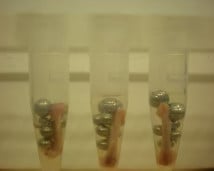
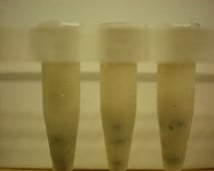
Leaves: Place 4 ZrO beads, 2mm diameter, in a 2.0 mL microtube, along with 250 uL of buffer.  Snap 1/2 cap of a fresh green leaf.  Then add another 250 uL of buffer.  (If you add all the buffer before the leaf sample, the leaf will float).  Run at speed 8 for 3 minutes.

A. thaliana leaf tissues and seedlings:  For tissue homogenization prior to protein and genomic DNA extractions.  Prior to tissue collection place 3 or 4 stainless steel beads, around 1.5mm diameter, into the microcentrifuge tube.  Then collect the tissue and snap freeze the tube in liquid nitrogen.  Once frozen, place tubes into the bullet blender and pulse the samples 3 or 4 times to disrupt the tissue.  After adding extraction buffer (whatever amount the protocol calls for, usually around 450-500uL)  homogenize in the blender at speed 8 for 2 or 3 minutes.  This extraction step has yielded high quality results in beta-GUS fluorimetric assays and has made PCR-screening transgenic lines a much smoother process.


Back to Top


Tissue and Organs:

Chicken muscle: 0.2 g of tissue cut into several pieces, equal volume of 0.5 mm diameter zirconium silicate or zirconium oxide beads, 0.5 mL buffer, speed 8 for 3 minutes.

Beef muscle: 200 mg of tissue cut into several pieces with 300 mg of 0.5mm zirconium silicate or zirconium oxide beads.  Run 2 minutes at speed 8 with 0.4 mL buffer.  Test results in mg/mL of lysates, performed in duplicates with 0.3 g of 0.5mm glass beads.:  0 min - 2.25; 1 min - 3.25, 4.3;  2 min - 4.92, 5.14;  3 min - 5.31, 5.33

Liver: 200 mg of beef liver cut into several pieces with equal volume of 0.5mm zirconium silicate or zirconium oxide beads and 0.4 mL buffer.  2 minutes at speed 8.
Test results in mg/mL of lysates, performed in duplicates using 0.3 g of 0.5mm glass beads:
0 min - 2.62; 1 min - 6.8, 8.11;  2 min - 9.42, 10.46;  3 min - 10.54, 10.11

Mouse jejunum and stomach tissue:  The tissue was frozen in liquid nitrogen (no fixative), we used a setting of 8 for 2 minutes and put 200 µl of 0.5 mm glass beads in an Eppendorf tube and 600 µl of Qiagen buffer.

Trachea: 200 mg of tissue, i.e. entire rat trachea.  0.2 g of 1.6mm stainless steel balls.  400 microliters PBS (or 1:2 PBS/acetonitrile mixture).

Hair: 25 mg of hair, 1.0 mL of buffer, 0.1 mL of glass beads, 10 min at 95C, then place in Bullet Blender for 3 min at speed 8.    Spin 2 min at 14K RPM.

Lung (using 50 mL tubes): 0.9g  rat lung (whole lobe), 2.5mL PBS, 5.0 mL acetonitrile, 6.7g 3/16 in. (4.8mm) stainless balls.  6 min speed 8 in Bullet Blender™ Blue 50, centrifuge 500 rpm 5 min.  Also successful: 0.7g rat lung (whole lobe) tissue, 10.0 mL PBS, 6.7g 3/16 in. (4.8 mm) diameter stainless steel balls.

Aorta:  Load 3 stainless steel beads (1.6 mm dia) in each microcentrifuge tube.  Add 25 - 50 uL buffer (your choice, depending on your downstream application).  Place dissected tissue into the buffer, then place the tube into the Bullet Blender™.  Set the time to 4 minutes and the speed to 8.

Brain:  Load  100 uL of glass beads (0.5 mm dia) in each microcentrifuge tube.  Add 100 - 200  uL buffer (your choice, depending on your downstream application).  Place about 100 mg of dissected tissue into the buffer, then place the tube into the Bullet Blender™.  Set the time to 3 minutes and the speed to 6.


Back to Top


HeLa Cells: HeLa cells lyse very effectively using 2x10⁷cells/mL  in lysis buffer without beads, with the Bullet Blender running for 2 min at a setting of 5 in a cold room (4°C), to yield a lysate containing ~5mg/mL protein.  HeLa cells were trypsinized, washed with PBS and resuspended in a mild lysis buffer (0.5% NP-40, 100mM KCL, 10mM HEPES, 5mM MgCl2) at a density of 2x10⁷ cells/mL.  The measurements were made using the BioRad Quick Start Bradford Dye Reagent with bovine serum albumin as the protein standard and absorbance at 595 nm measured on the NanoDrop spectrophotometer.

Back to Top